
Nearshore IT Teams for Industrial Companies: A Practical Guide
How industrial IT leaders close capacity gaps with nearshore specialists — productive in weeks, not months, led by your own managers under Swiss contracts.
Industrial companies do not have an IT ambition problem. They have an IT capacity problem.
A mid-sized manufacturer wants predictive maintenance on the shop floor. A logistics operator needs its warehouse and transport systems connected. A construction group wants its site teams off paper and into apps. The strategy is clear; what’s missing is the people to build and run it — and in the DACH region, those people are extraordinarily hard to hire.
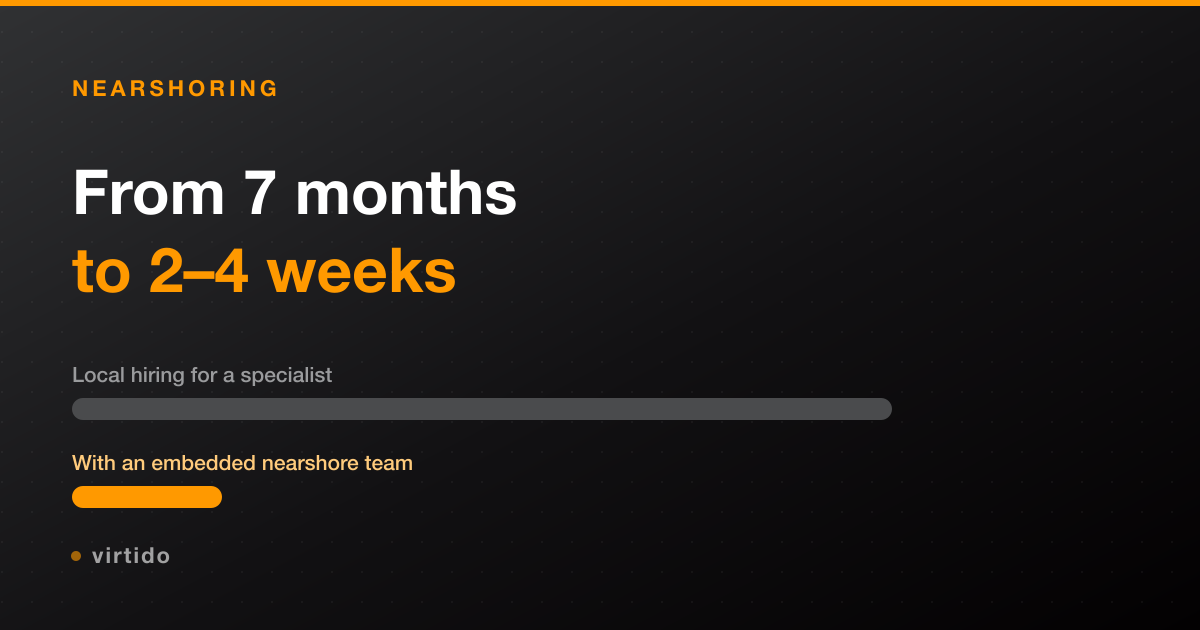
In short: Industrial IT leaders face a structural talent shortage that local hiring can't solve fast enough. Nearshore IT teams — specialists in nearby countries, integrated into your own team — put a selected specialist to work in two to four weeks, at 40–60% lower cost than a comparable Western-European hire. The model only works when you keep control: your managers lead the work, while the partner handles recruitment, employment and compliance.
The capacity gap is structural, not temporary
The shortage of IT specialists in German-speaking Europe is no longer a cyclical dip. Germany’s Bitkom industry association reported around 79,000 unfilled IT roles in 2026 — down from a record 149,000 in 2023 — yet a typical IT vacancy still stays open about 7.7 months, 97% of companies with IT openings report difficulty filling them, and 76% expect the shortage to worsen. The raw count has fallen from its peak, but hiring stays slow and hard. The Swiss market is comparably tight, with salaries climbing year after year.
For industrial companies this bites harder than for digital-native firms. IT is a support function competing for budget with production lines and plant investment, not the core product. The employer brand rarely attracts scarce cloud, data or enterprise-platform engineers away from tech companies. And the work is unglamorous but essential: keeping ERP, MES-adjacent systems, warehouse software and internal applications running while slowly modernising them.
The result is a backlog that never clears. Projects slip. Shadow IT grows. The existing team burns out covering operations and change at the same time.
What a nearshore IT team actually is
Nearshoring means working with specialists in countries close to you — for DACH companies, typically Poland, Ukraine and the wider Central and Eastern European region, with offshore options further afield for scale and support coverage.
The important distinction is how those people work with you. Three models often get confused:
| Model | Who leads the work | Best for |
|---|---|---|
| Project outsourcing | The vendor owns scope and delivery | A bounded project you want handed over |
| Freelancers | Mixed; often sit outside your process | A short, isolated task |
| Nearshore staff augmentation | You do — specialists join your team | Ongoing capacity and skills gaps |
With staff augmentation, the specialists are employed by the partner and embedded in your organisation. They join your stand-ups, your board, your repository and your release process. Your managers set priorities and accept the work. That distinction matters most to industrial buyers, because the domain knowledge — how your plant, your logistics network or your products actually work — stays inside your team. You are buying capacity and skills, not handing over a problem. (If you’re weighing the two approaches directly, see staff augmentation vs. outsourcing.)
The goal isn’t to externalise a system. It’s to add the people your own team is missing, and keep ownership where it belongs.
Why the model fits industrial companies
Speed that matches project reality
When a line-modernisation or systems-integration project has a window, a multi-month hiring cycle is not an option. A nearshore partner that already knows its talent pool can present candidates within days and have a selected specialist contributing in two to four weeks — depending on the role, candidate availability and your onboarding. Assembling a full team naturally takes longer. You interview and choose the people; nobody is assigned to you from a bench.
Access to scarce, specific skills
Industrial IT needs are broad and often niche: an SAP or enterprise-platform specialist here, a data engineer to make machine data useful there, a Power Platform developer to replace a spreadsheet process, DevOps capacity to stabilise infrastructure. Nearshore regions have deep, senior talent across exactly these areas — often easier to find there than locally. Our guide to nearshore software development goes deeper on where that talent sits and how to engage it.
Cost that survives a CFO review
A senior nearshore or offshore specialist typically costs 40–60% less, per role, than a comparable, fully-loaded in-house hire in Western Europe at similar seniority. Just as important for industrial budgets: you avoid the fixed overhead of permanent headcount for work that scales up and down with your project roadmap.
Continuity without lock-in
Freelancers often rotate out and take hard-won product context with them. A permanent hire can be slow to onboard and costly to release. An embedded nearshore team is built for continuity — the same people, retaining your context quarter after quarter — while still letting you scale down cleanly (with Virtido, on 30 days’ notice) when priorities shift.
This is not theoretical in industry. For BenLink, a Bühler Group field-service platform, Virtido recruited, employed and embedded web, mobile and IT-operations specialists who worked as BenLink’s own team under the client’s CTO, with low turnover over time. The client led the roadmap and technical direction; Virtido handled recruitment and employment. It is a concrete example of how you can build a dedicated development team that behaves like your own.
How an engagement works
A sound nearshore engagement is transparent and commits you to nothing until you’ve chosen your people:
- Scope. Map the roadmap, stack, team shape and how the specialists will be managed. Agree success criteria.
- Source. The partner recruits against the agreed role profiles — not from a bench — and sequences interviews.
- Interview and select. You interview shortlisted candidates and select the team incrementally. The contract is signed only after you’ve chosen.
- Integrate. The specialists join your tools, rituals and codebase and start working under your lead.
- Scale. Grow, adapt or reduce the team as the roadmap changes; the partner handles HR, payroll and contracts throughout.
A single specialist follows the same path as a full dedicated team — you can start with one person and grow, or start with a team and dial back.
What to watch for
Nearshoring is not automatically successful. The failure modes are predictable, and avoidable:
- Treating it as hand-off. If you brief a nearshore team like an outsourcer and disappear, you get outsourcer results. Integrate them and lead them.
- Buying from a bench. Insist on specialists recruited for your role profile and interviewed by you — not whoever is available.
- Vague responsibility. Be explicit about who owns priorities, technical decisions and acceptance. Ambiguity here is where engagements quietly fail.
- Ignoring data and IP terms. Confirm the contractual jurisdiction, IP transfer and system-access model before work starts, not after.
- One-off framing. The biggest gains come from continuity. Plan for the team to retain context, not to be rebuilt every quarter.
Where Virtido fits
Virtido recruits nearshore and offshore IT specialists for industrial companies and embeds them in your existing team. You choose the people and lead the work; we handle recruitment, employment, equipment and compliance — with a named partner in Switzerland and contracts under Swiss law.
- Individual specialists or full teams — start with one person and scale, or stand up a dedicated team, from one partner.
- Recruited for your stack — every engineer is sourced for your role profile, never pulled from a bench.
- Productive in 2–4 weeks — first profiles in days; you interview and select before any commitment.
- Swiss governance and IP — Swiss-law contracts, full IP transfer, data-protection matched to your delivery location.
- A decade with industrial clients — rail infrastructure, building-systems engineering, field-service platforms and more.
If your IT roadmap is clear but your team is stretched, that’s exactly the gap this model is built to close.