
Staff Augmentation vs. Outsourcing for Industrial IT
Staff augmentation buys capacity you lead; outsourcing hands a project to a vendor. How industrial IT leaders in DACH choose and keep knowledge in-house.
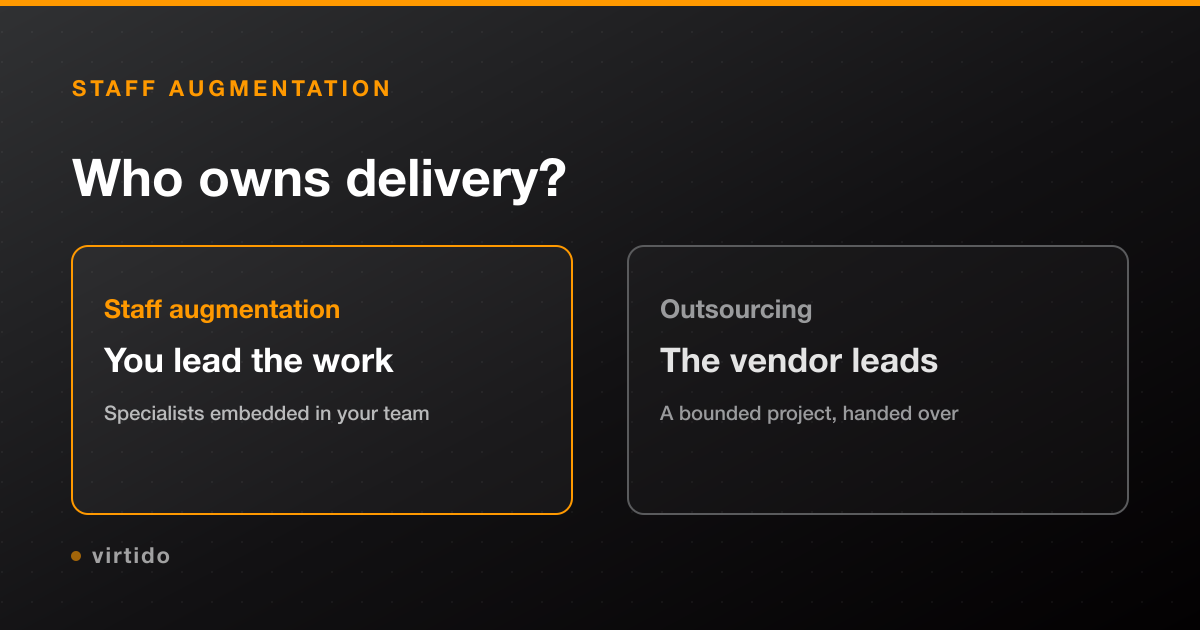
Most “staff augmentation vs. outsourcing” comparisons treat the two as interchangeable ways to buy cheaper engineering hours. For an industrial IT leader, that framing hides the one decision that actually matters.
The real question is not price per hour. It is who runs the work — and where the knowledge ends up when the engagement is over.
In short: Staff augmentation means you buy capacity and keep control — specialists are embedded in your team and led by your managers; outsourcing means you hand a bounded project and its delivery to a vendor who owns the result. Outsourcing is the right call for self-contained, well-specified work you are happy to delegate, but for ongoing capacity and domain-heavy industrial systems, augmentation keeps priorities, control and hard-won knowledge inside your own team.
Two models that solve different problems
Both models bring in people from outside your company. That is where the similarity ends. The difference is structural: it changes who decides what gets built, who is accountable for delivery, and who holds the knowledge afterwards.
Staff augmentation: you buy capacity and keep control
Staff augmentation adds specialists to your existing team to close a skills or capacity gap. They work under your management, in your tools, on your board, inside your repository. Your managers set priorities, make the technical calls and accept the work. The specialists are employed by the provider — recruitment, employment, payroll and compliance sit with the partner — but the direction of the work sits with you.
You are not handing over a problem. You are adding the people your own team is missing and leading them yourself. The system stays yours; the domain knowledge stays inside your walls.
Outsourcing: you hand a bounded project to a vendor
Outsourcing delegates a defined project, process or function to an external vendor. The vendor assembles and manages its own team, decides how to deliver, and is accountable — under contract — for hitting the agreed scope, timeline and quality. You define the outcome you need and review it at milestones; the vendor decides how to get there.
You are buying a result, not capacity you direct. Your involvement shifts from daily leadership to specifying requirements and accepting deliverables.
The real difference: who owns delivery
Strip away the cost tables and one word separates the two models: ownership of delivery.
With augmentation, you own delivery. The embedded specialists supply the hands and the skills, but the plan, the priorities and the acceptance are yours. If the roadmap shifts on Tuesday, you re-point the team on Tuesday — no change order, no renegotiation.
With outsourcing, the vendor owns delivery. That is the point of the model, and it is a genuine benefit when the scope is clear: the vendor carries delivery risk and you carry less management load. But it also means the vendor decides sequencing, staffing and method, and changing direction means changing the contract.
Everything else — cost structure, speed, knowledge retention, IP — follows from that single distinction.
| Factor | Staff augmentation | Outsourcing |
|---|---|---|
| What you buy | Capacity and skills you direct | A delivered result |
| Who owns delivery | You — your managers lead | The vendor, under contract |
| Control | Priorities, technical direction, acceptance stay with you | You set the outcome; the vendor runs the how |
| Cost shape | Per specialist; no project-management markup | Fixed or milestone price, delivery markup included |
| IP | Full transfer to you (Swiss-law contracts with Virtido) | Per the statement of work; varies by vendor |
| Domain knowledge | Stays and compounds inside your team | Largely sits with the vendor; can leave at contract end |
| Continuity | Same people retaining your context over time | Team dissolves when the project closes |
| Best for | Ongoing capacity, domain-heavy, evolving work | Bounded, well-specified, non-core projects |
When outsourcing is the right call
This is not a case against outsourcing. For the right work, handing delivery to a vendor is the cleaner, faster choice — and pretending otherwise would be dishonest.
Outsourcing fits when:
- The scope is bounded and well-specified. A one-off marketing website, a self-contained system integration with clear interfaces, a fixed-scope rollout with defined acceptance criteria. If you can write down exactly what “done” looks like, a vendor can deliver it.
- The work is not core to your operation. Functions that don’t touch your competitive advantage or your plant-floor knowledge can often be delegated without losing anything strategic.
- Requirements are stable. Outsourcing rewards clarity. When the target won’t move much, the vendor can plan efficiently and you benefit from a predictable price.
- You want to transfer delivery risk. A fixed-scope contract moves accountability for the result onto the vendor. When budget certainty matters more than flexibility, that trade can be worth it.
If that describes your project, outsource it with a clear statement of work and defined acceptance — and don’t try to micromanage a model built on delegation.
When augmentation wins for industrial IT
Industrial IT rarely looks like a bounded project. It looks like a standing backlog against a lean team: ERP and warehouse systems to keep running and slowly modernise, machine data to make useful, a Power Platform process replacing a spreadsheet, DevOps capacity to stabilise infrastructure. The work is ongoing, it evolves, and it is soaked in domain knowledge about how your plant, logistics network or products actually behave. This is the pattern we see most often when nearshore teams work with industrial companies.
That is exactly where augmentation wins, for four reasons.
Control stays where the accountability is. In regulated, safety-adjacent industrial environments, the IT leader who answers for the system needs to direct it. Augmentation keeps priorities, technical direction and acceptance in your hands rather than behind a vendor’s project wall.
Domain knowledge compounds in-house. The hardest thing to replace in industrial IT is context — the quirks of a line, an integration, a decade of decisions. Embedded specialists accumulate that context inside your team and keep it there. Outsourced knowledge tends to leave with the vendor.
It flexes with an evolving roadmap. Ongoing capacity needs change quarter to quarter. You can grow, re-skill or scale the team down (with Virtido, on 30 days’ notice) without reopening a contract each time the plan shifts.
The economics fit ongoing work. A senior nearshore or offshore specialist typically costs 40–60% less than a comparable, fully-loaded in-house hire in Western Europe at similar seniority, with no project-management markup — and you avoid the fixed overhead of permanent headcount for work that scales with your roadmap. A selected specialist is usually productive within two to four weeks, so capacity arrives at project speed, not hiring speed. (Assembling a full dedicated team takes longer.)
The honest rule of thumb: if you can fully specify the result and happily hand it over, consider outsourcing. If the work is ongoing, domain-heavy and something you need to keep steering, augment your team and keep the knowledge at home.
A quick decision checklist
Neither model is better in the abstract — the right one depends on the work in front of you. Use these two lists to place a specific piece of work. If a project genuinely lands on the outsourcing side, outsourcing is the better call, and no amount of in-house preference changes that.
Choose staff augmentation when:
- The need is ongoing or evolving capacity, not a one-time deliverable with an end date.
- The work is domain-heavy and context must stay in-house — losing it at contract end would hurt.
- You want to keep technical control: priorities, architecture decisions and acceptance in your own managers’ hands.
- You are filling roles, not shipping a bounded project — you know the skills you lack, not a fixed scope you can sign off.
- Requirements will shift, and you need to re-point effort without renegotiating a contract.
Choose project outsourcing when:
- The deliverable is genuinely bounded and well-specified, with a clear, written definition of “done” and acceptance criteria.
- It is non-core work that does not touch your competitive advantage or plant-floor knowledge.
- Transferring delivery risk is worth giving up day-to-day control — budget and timeline certainty matter more to you than flexibility.
- You do not need the resulting knowledge to live inside your team afterwards, or you have planned an explicit handover.
A realistic case where outsourcing wins: a fixed-scope customer portal built on a standard stack, with signed-off requirements, clear interfaces and a hard go-live date — work no one on your team will maintain long-term. Handing that to a vendor on a statement of work transfers the delivery risk and frees your own people for the domain-heavy systems only they can run. Trying to augment for a job like that just adds management load you did not need to carry.
If you are unsure which side a given project falls on, that uncertainty is itself a signal: the scope probably is not bounded enough to outsource cleanly yet. Talk it through with us before you commit either way.
Where Virtido fits
Virtido is a pure resource play. We recruit and employ nearshore and offshore IT specialists for industrial companies and embed them in your existing team. You choose the people, set the priorities and accept the work; we handle recruitment, employment, equipment and compliance — with a named partner in Switzerland and contracts under Swiss law with full IP transfer.
- You keep control — priorities, technical direction and acceptance always stay with your managers; we never take over delivery.
- Recruited for your stack — every specialist is sourced for your role profile and interviewed by you, never selected on availability alone.
- Productive in 2–4 weeks — first profiles in days; you select before any commitment, and scale down on 30 days’ notice.
- Swiss governance and IP — Swiss-law contracts, full IP transfer, data protection matched to your delivery location.
- A decade with industrial clients — 10+ years and 500+ placements across rail, building-systems engineering, field-service platforms and more.
If your work is a bounded, one-off project, a good outsourcing partner may serve you better — and that’s a fair answer. But if it’s ongoing capacity for domain-heavy industrial IT, the model that keeps knowledge and control in-house is the one that pays off.