
Nearshore Software Development: How It Works and What It Costs
How nearshore software development works for industrial IT leaders: engagement models, real costs (40–60% less), locations and collaboration — led by your team.
Nearshore software development has a reputation problem that has nothing to do with whether it works. For every industrial IT leader who has quietly scaled a product team across Central Europe, there is another who has heard a horror story: a vanished vendor, a mystery invoice, code nobody can maintain. Both are real. The difference is almost never the location — it’s how the engagement was set up.
In short: Nearshore software development means building software with specialists in nearby countries that share your working day — for DACH firms, Poland and Ukraine, with the Philippines offshore for scale and support. It works as a resource model where your managers lead and the partner employs and administers the people, with senior talent running 40–60% below a comparable, fully-loaded Western-European hire.
What nearshore software development actually is
Nearshoring means working with software specialists in countries close to you — close enough that most of the working day overlaps. For companies in Germany, Switzerland and Austria, that means Central and Eastern Europe, with Poland and Ukraine as the two deepest talent markets, plus offshore locations further afield when you need follow-the-sun coverage or large-scale support.
The word “nearshore” describes geography. It does not, on its own, tell you how the people work with you — and that is the part that decides whether an engagement succeeds. The practical question for an industrial IT leader is not “which country?” but “who leads the work, and who holds the domain knowledge afterwards?”
In the model this guide describes, the specialists are employed by the partner and embedded in your team. They join your stand-ups, your board, your repository and your release process. Your managers set priorities and accept the work. The partner handles recruitment, employment, payroll, equipment and local compliance. You are buying capacity and skills — not handing over a scope and hoping it comes back as you imagined. That distinction matters most to industrial buyers, because how your plant, logistics network or product actually works is knowledge you cannot afford to export along with the code.
The engagement models you’ll be offered
Three models get grouped under “nearshore software development,” and they are not interchangeable.
- Project outsourcing. The vendor takes a defined scope and delivers it. You get an outcome but give up day-to-day control, and the domain knowledge largely stays with the vendor. Fine for a bounded, self-contained build; risky for anything entangled with your core operations.
- Freelancers. Individual contractors, often working partly outside your process. Flexible and fast for a short, isolated task — but continuity and accountability are weak, and context leaves when they do.
- Staff augmentation (the embedded model). Specialists are recruited for your role profile, employed by the partner and integrated into your team under your lead. Best for ongoing capacity and skills gaps where continuity and control matter. (If you’re weighing this against handing over a scope, our staff augmentation vs. outsourcing comparison goes deeper.)
For most industrial software work — extending an ERP integration, building a field-service app, stabilising a data pipeline, keeping internal applications alive while you modernise them — the embedded model is the one that keeps ownership where it belongs. You can start with a single specialist and grow, or stand up a dedicated team and dial it back later; the path is the same.
What it costs and how pricing works
Honest cost conversations start by separating the rate from the total cost of a productive, retained engineer. A cheap rate attached to someone who underperforms and leaves after three months is not cheap.
Two pricing models dominate:
| Pricing model | How you’re billed | Best for |
|---|---|---|
| Time-and-materials | Actual hours worked, invoiced per period | Variable, exploratory or hard-to-scope work where effort fluctuates |
| Monthly flat rate (dedicated FTE) | A fixed monthly fee per full-time specialist | Ongoing capacity you can plan for — a predictable budget line |
Virtido bills time-and-materials and also offers monthly flat rates for dedicated full-time specialists, so you can match the commercial model to how predictable the work is. What no serious partner should do is hand you a tidy price list, because the rate depends heavily on role, seniority and delivery location. A senior cloud engineer, a mid-level .NET developer and an L2 support specialist are different numbers — which is why rates are quoted per role, against the profile you actually need.
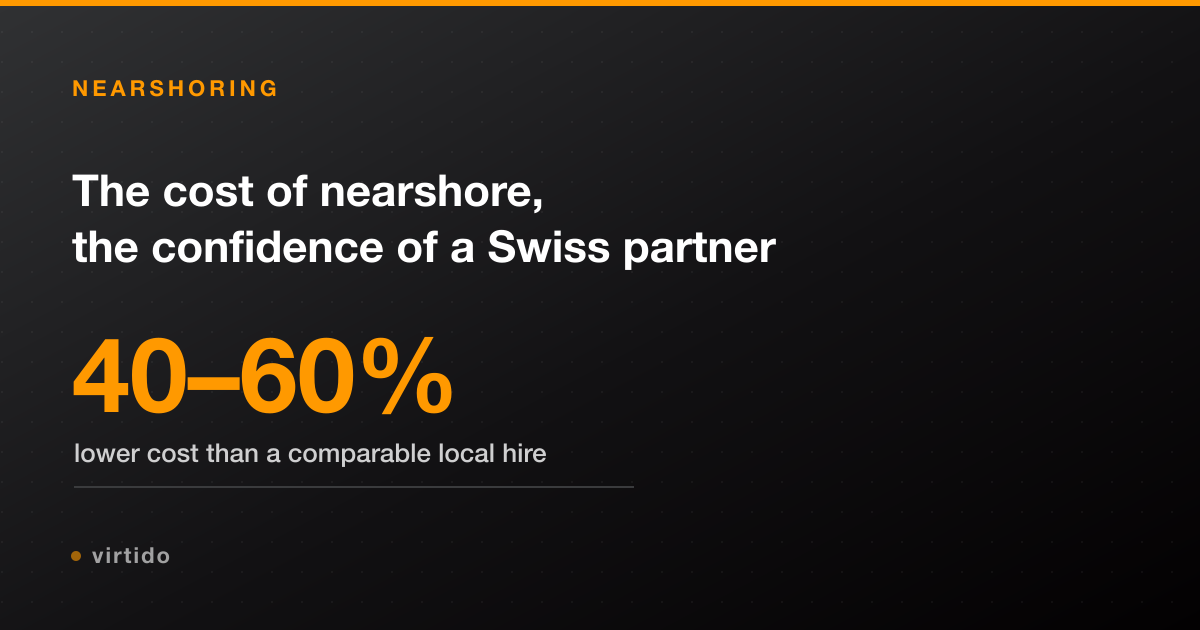
The anchor worth remembering: a senior nearshore or offshore specialist typically costs 40–60% less than a comparable, fully-loaded in-house hire in Western Europe at similar seniority — “fully-loaded” meaning you count everything a permanent hire actually costs, not just base salary. Just as important for an industrial budget, you avoid the fixed overhead of permanent headcount for work that scales up and down with your roadmap. The right question for a vendor is never “what’s your hourly rate?” — it’s “what does a productive, retained engineer on my product cost me, all in?”
An illustrative cost comparison
The table below is illustrative, not a quote — it shows the shape of the comparison, not a price you’d be invoiced. The assumptions: a senior backend engineer at similar seniority on both sides; the in-house column counts the fully-loaded cost of a permanent hire, not just salary; and both reflect typical utilisation over a year. Real figures move with your market, the exact role and the delivery location.
| Cost component (senior backend engineer) | In-house, Western Europe (illustrative) | Nearshore FTE via Virtido (illustrative) |
|---|---|---|
| Gross salary | High five figures to low six figures / year | — (included in flat rate) |
| Employer social contributions & benefits | ~+15–25% on salary | Included |
| Overhead, tooling, workspace | Further on-cost per head | Included |
| Recruitment & ramp-up | One-off, plus weeks-to-months to hire | Included; first profiles in days |
| Typical utilisation | Absence, admin, non-billable time | Priced as a dedicated monthly FTE |
| Fully-loaded total | Baseline (100%) | ≈ 40–60% lower, all in |
Rates are always quoted per role, and seniority and location move them a long way: a certified SAP consultant in Poland and an L1 support engineer in the Philippines sit at very different points on the scale. Treat the 40–60% band as the saving on a like-for-like senior comparison, not a flat discount on every profile. For the broader case on why and when nearshoring pays off for an industrial organisation, see our guide to nearshore IT teams for industrial companies.
Where we deliver and why time zones matter
Time-zone overlap is the whole point of nearshore. It is what lets a developer in your team join the same stand-up, answer the same question in the same hour, and pair on the same problem — instead of trading messages across a half-day gap.
| Location | Type | Working-hour overlap with DACH | Best for |
|---|---|---|---|
| Poland | Nearshore | Full working day | Core development, close collaboration |
| Ukraine | Nearshore | Full working day | Core development, deep senior talent |
| Philippines | Offshore | Partial (follow-the-sun) | Scale and L1–L3 support coverage |
Virtido delivers nearshore from Poland and Ukraine, which give DACH companies a near-complete working-day overlap — the condition for real-time collaboration on a fast-moving product — and offshore from the Philippines for follow-the-sun scale and round-the-clock L1–L3 support. Many industrial teams blend the two: nearshore specialists for core development where tight collaboration is essential, offshore capacity for support coverage that benefits from a different time zone. Multi-location delivery also lets you distribute concentration risk rather than placing an entire team in one place.
Setting up collaboration and governance
An embedded engagement lives or dies on setup, not on good intentions. The parts worth getting right before anyone writes a line of code:
- One clear line of ownership. Be explicit about who sets priorities, who makes technical decisions and who accepts the work. Ambiguity here is where engagements quietly fail. In this model, that person is one of your managers.
- Your tools, your rituals. The specialists work in your repository, your board, your CI/CD and your stand-ups. Treat them as team members, not an external supplier at the end of an email thread.
- A documented starting point. The single biggest cause of slow productivity is expecting someone to “figure it out” from an undocumented codebase. Architecture notes, coding standards and deployment steps pay for themselves in the first fortnight.
- Access and IP settled up front. Confirm the contractual jurisdiction, IP transfer and system-access model — VPN, managed devices, data residency — before work starts, not after.
With a prepared partner and these elements in place, you typically see first candidate profiles within days, and a selected specialist contributing within two to four weeks of selection — depending on the role, candidate availability and your onboarding. That timing is for a single specialist; assembling a full dedicated development team takes longer, because you are recruiting and interviewing several interlocking roles rather than one.
Risks and how to de-risk them
Nearshore software development is not automatically successful. The failure modes are predictable, which means they are avoidable.
- Buying on rate alone. The cheapest provider rarely carries the screening, management and continuity you need. Low price often optimises the partner’s margin, not your delivery.
- Buying from a bench. Insist on specialists recruited and interviewed for your role profile — not whoever happens to be free this week. You should interview and select before you commit.
- Treating it as a hand-off. Brief an embedded team like an outsourcer and disappear, and you get outsourcer results. Integrate them and lead them.
- Leaving replacement undefined. People move on. The question is whether that’s a crisis or a managed process. Clarify notice, handover and replacement up front — Virtido works on 30 days’ notice, which cuts both ways and keeps you flexible.
- Treating compliance as boilerplate. IP ownership, GDPR coverage for each delivery location, NDAs and data residency deserve explicit attention, especially in regulated contexts — not a generic “we’re compliant.”
- Thinking one-off. The biggest gains come from continuity: the same people retaining your context quarter after quarter. Plan for retention, not a team rebuilt every three months.
Where Virtido fits
Virtido recruits nearshore and offshore software specialists for industrial companies and embeds them in your existing team. You choose the people and lead the work; we recruit, employ, equip and administer them — with a named partner in Switzerland, contracts under Swiss law and full IP transfer. Billing is time-and-materials or a monthly flat rate per dedicated specialist, nearshore from Poland and Ukraine, offshore from the Philippines, with specialists productive in two to four weeks and 30 days’ notice to scale down. If your software roadmap is clear but your team is stretched, that is exactly the gap this model is built to close.