
Staff Augmentation vs. Freelancers for Industrial IT Teams
Freelancers vs. augmented specialists for industrial IT leaders: how employment, replacement responsibility and IP decide which fits a given piece of work.
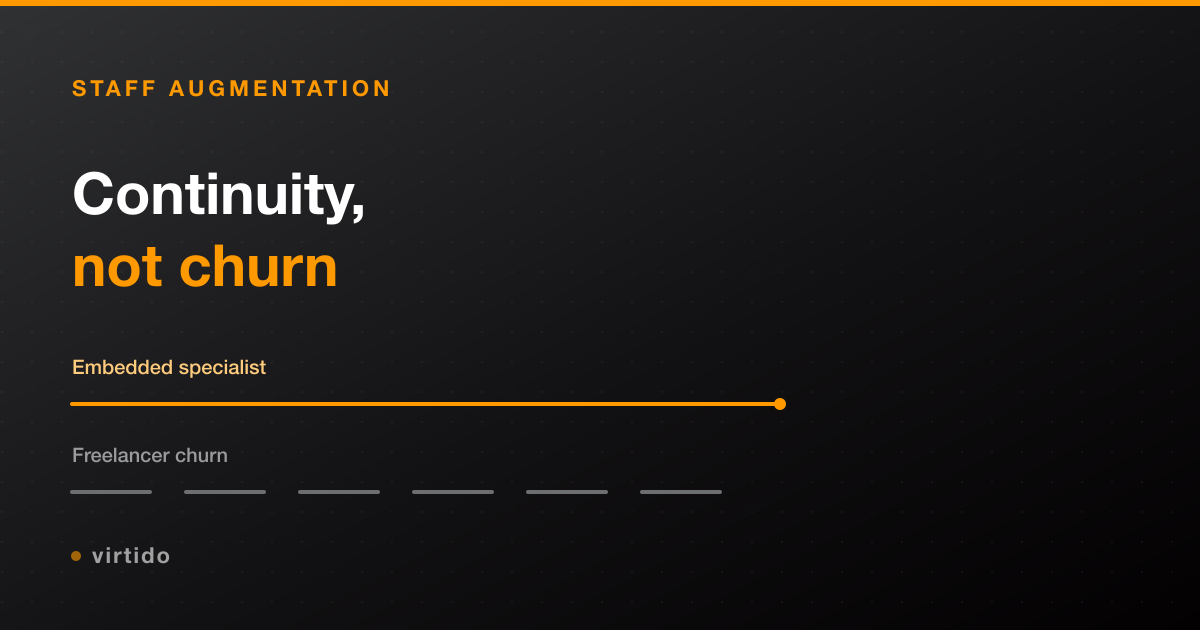
An industrial IT leader rarely asks “freelancer or augmented specialist?” in the abstract. The real question is narrower and more practical: this particular piece of work — does it suit someone you brief and release, or someone you embed and lead for the long run?
In short: Freelancers are a sound choice for short, well-scoped, isolated work. Augmentation is built for continuity-dependent, domain-heavy work where replacement and IP responsibility should sit with a partner rather than with you. The real differences are employment, sourcing and who carries that responsibility — not personality traits of "freelancers."
What each model actually is
A freelancer is self-employed and markets their own services. You engage them directly, define the deliverable, agree a rate, and they do the work — frequently alongside other clients. A freelancer can work inside your tooling and rituals and can stay on a long engagement; what stays with you is sourcing, vetting, the contract, and finding a replacement yourself if it doesn’t work out. For a bounded task with a clear specification, that lightness is a feature.
Staff augmentation adds external specialists to your team as working members. With Virtido, the specialist is recruited for your role, employed by Virtido and embedded in your organisation: they join your stand-ups, your board, your repository and your release process, and work under your direction. You still lead — this is a pure resource play, not outsourcing — but the partner handles recruitment, employment, payroll, equipment and local compliance.
So the honest differences aren’t personality traits of “freelancers.” Either kind of contributor can learn your domain, and either can leave. What actually differs is who employs them, how they were sourced (recruited for your role versus self-marketed), who carries replacement responsibility if someone leaves or isn’t a fit, how IP and compliance are arranged, and the working arrangement you agree. Those are the levers that decide which model fits a given piece of work — and they’re why augmentation tends to suit continuity-dependent, domain-heavy work while freelancing suits sharp, isolated tasks.
Where freelancers genuinely fit
This is not an argument against freelancers. Plenty of industrial IT teams use them well, and for the right work they are the better choice. Freelancers fit when the work is:
- Short and bounded — a one-off data migration, a specific integration, a plugin or report build with a clear finish line.
- Isolated from your core process — a landing page, a design asset, a standalone utility that doesn’t need to live inside your team’s daily rhythm.
- A specialist one-shot — a security review, a performance audit, an expert opinion where you want a named individual’s judgement for a few days, not a seat on the team.
- Experimental — validating whether a skill or approach is worth pursuing before you commit to it at scale.
For all of these, a freelancer’s speed to start and pay-per-task economics are genuinely efficient. If you have the capacity to vet and manage contractors, there is no reason to over-engineer the engagement.
Continuity, control, compliance and IP compared
The models diverge most on the things that decide whether ongoing work succeeds. Here is the honest comparison:
| Factor | Freelancers | Augmented specialists (Virtido) |
|---|---|---|
| Employment | Self-employed; works for their own account | Employed by Virtido and seconded to your team |
| Sourcing | Self-marketed; you choose from who’s available | Recruited and interviewed for your specific role |
| Replacement responsibility | Yours — you re-source and re-onboard if someone leaves | The partner’s — re-sourcing and continuity sit with Virtido |
| Who leads | You do, and you also source, vet and contract | You do; the partner handles recruitment, employment and compliance |
| Working arrangement | Agreed per engagement; can be in or outside your rituals | Embedded in your stand-ups, board, repo and release process |
| Availability | As agreed; often shared across their clients | Dedicated hours on your work for the term of the engagement |
| Cost basis | Day rate; sourcing and any rework carried by you | 40–60% below a comparable Western-European hire, per role |
| IP & compliance | Rests on the contract you write and enforce | Swiss-law contracts, full IP transfer, inside your security policies |
| Best suited to | Short, isolated, well-scoped tasks | Ongoing work where continuity and domain context matter |
Two rows carry most of the weight for industrial teams. Replacement responsibility: when the person who learned how your warehouse software actually behaves moves on, someone has to re-source and re-onboard the next one. With a freelancer that task is yours; with augmentation it sits with the partner, which is what keeps continuity from becoming your problem. IP and compliance: a freelancer can work inside your perimeter, but IP assignment and data handling rest on the contract you write and police. Augmented specialists work inside your systems under Swiss-law contracts with full IP transfer along the chain, so that responsibility sits with a partner by default. If you are weighing this across several hiring routes at once, the talent-augmentation hiring guide sets out the wider set of options.
Why industrial IT often needs embedded continuity
Industrial IT work has a particular shape. It is rarely a single clean deliverable; it is a running programme — keeping ERP, warehouse and internal systems alive while slowly modernising them, on a roadmap that stretches across quarters. The value is cumulative: the person who understands why a legacy integration behaves the way it does on your shop floor is worth far more in month six than in week one.
That is the kind of work where per-task engagement can fight against you — not because freelancers are the wrong people, but because the arrangement isn’t built for it. If each phase is sourced separately, domain knowledge can reset between hand-offs; if the contributor’s availability is split across other clients, they may not be the one free when something breaks. None of this is inevitable with a freelancer — a good one on a long, exclusive engagement avoids much of it — but you are the one holding it together.
Augmentation builds the continuity in by default: the same specialists, embedded in your process, with replacement responsibility sitting with the partner — and without the fixed overhead and slow release of a permanent hire. If you are weighing that against building a whole dedicated development team, the trade-offs there are similar in spirit. With Virtido, continuity also comes with a clean exit: you can scale down on 30 days’ notice when the roadmap changes, so it never becomes lock-in.
The question is rarely “freelancer or not.” It’s “does this work need someone who keeps our context — or someone who finishes a task and hands it back?”
How to decide
A few questions separate the two cleanly for any given piece of work:
- Is the work bounded or ongoing? A clear deliverable with a finish line leans freelancer. A programme that runs for months leans augmentation.
- How much does context compound? If value grows as the person learns your systems and domain, continuity wins. If the task is self-contained, it doesn’t matter.
- Does it need to live inside your process? Daily collaboration, your tooling and rituals, shared ownership of a codebase — that’s an embedded specialist. A standalone artefact is fine for a freelancer.
- Who should carry replacement responsibility? If you have the capacity to re-source and re-onboard yourself and want the lightest engagement, freelancing is viable. If you’d rather that responsibility — along with employment and compliance — sit with a partner, augmentation removes that load.
- What are the IP and data stakes? Work touching sensitive systems or proprietary domain IP is safer inside your perimeter under Swiss-law contracts than on a contractor’s personal setup.
Most industrial IT teams end up using both — freelancers for the sharp, isolated tasks, augmented specialists for the continuity-critical core. The skill is matching the model to the work, not defaulting to one for everything.
Where Virtido fits
Virtido recruits and employs nearshore and offshore IT specialists for industrial companies and embeds them in your existing team. You choose the people and lead the work; we handle recruitment, employment, equipment and compliance — with a named partner in Switzerland and contracts under Swiss law. The model is built for the case freelancing covers less naturally: ongoing work where keeping your product and domain context inside the team is what makes the difference, and where replacement and IP responsibility are better carried by a partner than by you. A selected specialist is typically contributing within two to four weeks of selection, depending on the role and your onboarding, and per role costs 40–60% less than a comparable, fully-loaded local hire at similar seniority; you can scale back on 30 days’ notice. If a piece of work is short and isolated, a freelancer may well be the right call. If it’s a running programme that depends on continuity, that’s the gap this model is built to close.